Kubota Group: For Earth, For Life.
From Foundry to Global Corporation
Everything began with a vision. Company founder Gonshiro Ohde (who would later become Gonshiro Kubota) was convinced: "If you try hard, you can get it done". His success would prove him right. In 1890, the energetic young Japanese established a foundry in Osaka; his goal was to make a contribution to the well-being of society with his company. 136 years later, Kubota Group is a global corporation that upholds its founder’s ideals in over 150 countries around the world.
Established at the Dawn of a New Age
Gonshiro Ohde was born in the early years of the Meiji era – a time of rapid and radical change, when Japan was modernizing under the leadership of Emperor Mutsuhito. The emperor, who bore the honorary name Meiji ("enlightened rule"), initiated profound political, social, and economic reforms which turned Japan from an isolated, pre-industrial feudal state into a modern world power.
In this age of revolution, the 19-year-old inventor and entrepreneur founded Ohde Casting. Foundries, steel mills, shipyards, and coal mines played a key role in the Meiji industrial revolution. This was definitely true of Ohde Casting, one of the pioneering companies to domestically produce and mass-produce cast iron pipes for waterworks in Japan, making a significant contribution to improving the water supply – and thus to curbing the spread of infectious diseases. In 1897, Gonshiro Ohde took on the surname of his adoptive family Kubota. His company became the Kubota Iron Works – and the rest is history.
Our products should not only be technically excellent, but also useful for the good of society.Gonshiro Kubota
Technology with Responsibility
In keeping with its founder's vision, Kubota Group’s goal today remains to provide technological solutions that contribute to the well-being of people and the world they live in. With the brand statement “For Earth, For Life” the Group reflects this commitment in its logo. Our world currently faces many challenges, from waste and pollution to resource depletion. The impact is particularly devastating in the closely linked areas of food, water, and the environment. Through products and services that address challenges in these areas, Kubota Group aims to provide real value to society and contribute to a better future.
A look at Kubota’s core competencies illustrates just how consistently this philosophy has shaped the company’s history and development since its beginnings.
Pipes for Clean Water – and More
In Meiji-era Japan, imported infectious diseases like cholera were claiming numerous lives, and there was an urgent need for a reliable and clean water supply. However, the country lacked the necessary expertise to manufacture long, thin-walled cast-iron pipes capable of withstanding high water pressure; all required pipes had to be imported. For about four years, Gonshiro Kubota tirelessly produced one prototype after another. Finally, he developed a manufacturing process that became the basis for the modernization and expansion of Japan's water infrastructure. Today, Kubota provides not only earthquake-resistant connections and piping systems for water suppliers, but also high-quality pipes, valves, and pumps for the heavy and chemical industries.
Solutions for Agriculture
People's well-being depends largely on their diet. This is why agriculture is one of the oldest and most important economic sectors. Kubota has long been a pioneer in this field, developing agricultural machinery designed entirely with people's needs in mind. An early example is the horizontally mounted, water-cooled diesel engine that provided Japanese farmers with exactly the lightweight, easy-to-use power source they needed at the time.
Kubota's current portfolio includes products and services for all sectors of agriculture. Developers visit farms and observe all processes, from plowing and tilling to sowing, harvesting, and post-harvest processing. Close collaboration with farmers allows them to create practical solutions that meet real-world needs. For example, Kubota tractors are characterized by their compact size as well as their high performance and durability. Users with long workdays benefit from their comfort and maneuverability, while users not used to operating machinery appreciate how simple and intuitive they are to use.
Solutions like UV boosting – a technology developed by the French startup UV Boosting, who Kubota cooperates closely with – also aim to contribute to food security. This technology treats crops with high-intensity UV rays to boost their natural defenses. The treatment increases their resistance to drought, frost, and diseases, thus also reducing the need for chemical protective agents.
Engines: The Heartbeat of Industry
Kubota began manufacturing engines for agro-industrial purposes in 1922, including engines used for agricultural machinery such as threshing machines and pumps. Soon, the company began offering its successful engines to customers and supplying them to other manufacturers as OEM parts.
Today, the Group is committed to finding high-performance, eco-friendly solutions that will secure the future of our planet. For example, in 2022 Kubota approved nearly all of its diesel engines for use with HVO (Hydrotreated Vegetable Oil) synthetic fuel, which is derived entirely from non-fossil sources and reduces CO₂ emissions. Kubota was also among the first engine manufacturers to be certified under the first emissions regulations for industrial engines, the U.S. state California's “CARB ULG Exhaust Gas Regulations”. Since then, the company has consistently advanced its emission-reduction technologies further.
Kubota at a Glance
- Founded in 1890 as Ohde Casting
- Based in Osaka, Japan
- More than 52,000 employees worldwide
- Operations in over 150 countries
- 207 subsidiaries
- Consolidated revenue of 3,018.9 billion yen (approximately 17 billion euros)
- Core competencies:
- Water pipes and pipe systems
- Agricultural machinery and agriculture-related products
- Industrial engines
- Weighing and measuring control systems
- Construction machinery
- Water treatment systems
Precise Weighing and Measuring Instruments
The accurate measurement of raw materials is crucial for the production of high-quality products. Thanks to Kubota's casting expertise, the company quickly began manufacturing scales that stood out for their high precision. The first mechanical floor scale, introduced in 1924, was followed by numerous other industrial measuring instruments and weighing systems. After the war, they helped drive the country's revitalization and renewal. After Japan's oil crisis in the 70s, they were literally instrumental in mass production. And in today's information-driven society, they support digital transformation.
Kubota achieved a significant milestone in 2022. That year, the German feeding specialist Brabender Technologie – one of the world’s largest manufacturers of gravimetric and volumetric feeding systems and discharge devices – became the Group's subsidiary. Just one year later, the new subsidiary, together with its Japanese colleagues, obtained CE certification for Kubota's NX feeder and launched it on the European market: the first joint project under the new Kubota Brabender Technologie brand.
Machines for Constructing Urban Infrastructure
After World War II, Japan underwent an exceptionally rapid process of urbanization and industrialization. Building the necessary public infrastructure was a particular challenge. Kubota responded by developing compact construction machines like the first Kubota mini excavators, which were suitable even for small-scale urban construction work in confined spaces.
Today, Kubota’s construction machines – with their small turning radius and compact design – still deliver high performance in tight spaces. Low-noise models provide options for downtown areas or at night. By combining low-emission engines with high excavation performance, machines like the mini excavator are setting standards for the future of construction.
Wastewater Treatment and Recycling
The rapid economic growth after the war also made water and waste management a pressing issue. Ever since Kubota developed iron pipes for water, the company has been closely connected with the water supply industry. In order to maintain a healthy living environment in the growing Japanese metropolitan areas, the Group began to conduct research in the field of water treatment and developed technologies like non-diluted aerobic wastewater treatment and the contact oxidation process.
Water scarcity and pollution are problems that affect the entire world today. This is why the Group leverages its many years of expertise to provide clean water in as many regions as possible, actively involving itself in the treatment and recycling of wastewater and industrial effluents. Kubota's modern membrane bioreactor separates biological sludge from water by means of membrane filtration, making it easy to recover clear, purified water – more cost-effectively, in fewer process steps, and in smaller treatment facilities than the conventional activated sludge process.
For the prosperity of society, we need to put all of our efforts into creation.Gonshiro Kubota
Solutions for a Better Future
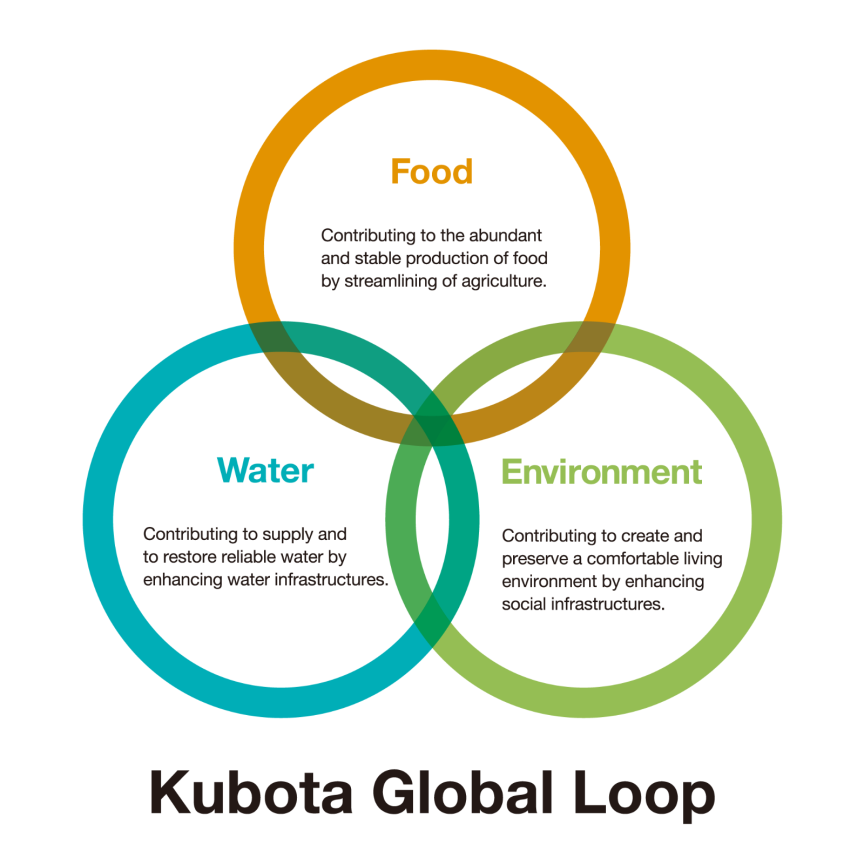
Since its founding in 1890, Kubota has undergone a complete transformation – but in one key respect, it has remained the same. From construction machinery and tractors, engines and precision feeders to pipes and water treatment systems: The Group is committed to leveraging its expertise to address challenges in the areas of food, water, and the environment. By doing so, it follows in the footsteps of its founder, Gonshiro Kubota, who sought to create technically excellent products in a small iron foundry in order to contribute to the prosperity of society.